"We are excited about Android Jelly Bean and are...
30/06/2012
HTC and Samsung issue statements on Android 4.1 updates
HTC and Samsung issue statements on Android 4.1 updates: Earlier this week Google introduced Android 4.1 Jelly Bean to the world, and after the announcement had been made, the first thing that likely sprung into the minds of many Android device owners was "When will I get it?" Google has already confirmed that the Galaxy Nexus , Nexus S and Motorola XOOM will be updated in mid-July, and now both HTC and Samsung have issued statements on Jelly Bean. HTC's announcement is as follows:
"We are excited about Android Jelly Bean and are...

"We are excited about Android Jelly Bean and are...

Ubuntu, Android pair up to knock Apple down
Ubuntu, Android pair up to knock Apple down:
Reportedly, the two Linux kernel based cousins- Ubuntu and Android can team up in the near future to knock Apple’s iOS down in the smartphone segment.
The strength of Apple lies in the simplicity and integrity of its iOS. Everything is tightly bound and that makes it relatively easy to use and easy to familiarize with. That’s probably what makes it the world’s hottest smart-phone selling brand.
While the strength of apple lies in simplicity, the strength of Android lies in diversity. By Diversity, we mean more support, more features and more compatibility. For instance, iPhone doesn’t have the ability to be docked in and act like a computer.
Though Android sold like hotcakes in 2012 and has out-powered iOS, iPhones have been spread across major carriers and the ba se price has dropped below 100$.Android quite eminently wants to overpower iOS and seems to leave no stone unturned in doing just that.
Well, for starters, Ubuntu wants to bring innovation in the smartphone segment by 2012 and it foresees smartphone/PC convergence. It’s teaming up with Android hardware experts to develop a system which can bridge the smartphone/PC gap.
Interestingly, Ubuntu developers revealed that the smartphones would behave normally when they’re not docked in. It’s only when they are pinched with those pins below them, would they magically transform into computers. The integration would be relatively easier as both the OS lay its roots on Linux kernels. In layman terms, they speak the same language,
It has also been noted that the Ubuntu OS is so lean that it can be stocked in 2 GB and would include apps for email, web browsing, photo editing and music.
However, Mr Collins, the Product manager of Ubuntu for Android said that it will take close co-operation and cohesion to optimize the hardware performance of each smartphone to lay grounds for its elite open-source OS. He was positive about Ubuntu being integrated into high-end Android phones by 2012.
How fascinating do you think this is? Would this family reunion change the dynamics of the smartphone/computer world?
Dock your thoughts in.
Nokia Says It Can Still Differentiate With Location-based Services Even After Losing Nokia Drive Exclusivity
Nokia Says It Can Still Differentiate With Location-based Services Even After Losing Nokia Drive Exclusivity:

At Nokia Conversations blog today, there was an interesting post on Location-based services on mobile devices. One of the biggest differentiator of Nokia Windows Phone devices are their Location based apps such Nokia Drive, Nokia Transport, Nokia Maps, etc,. Recently, Microsoft announced that Nokia Drive will offer turn-by-turn navigation solution to all Windows Phone 8 based devices. Many of readers raised concerns about Nokia losing its exclusivity to other Windows Phone OEMs.
Here is the response from Nokia on this issue,
More than that, Nokia provided an interesting analogy to explain the Location platform which will power various services in the future,
Read more at Nokia Conversations.


At Nokia Conversations blog today, there was an interesting post on Location-based services on mobile devices. One of the biggest differentiator of Nokia Windows Phone devices are their Location based apps such Nokia Drive, Nokia Transport, Nokia Maps, etc,. Recently, Microsoft announced that Nokia Drive will offer turn-by-turn navigation solution to all Windows Phone 8 based devices. Many of readers raised concerns about Nokia losing its exclusivity to other Windows Phone OEMs.
Here is the response from Nokia on this issue,
Nokia Drive might not be exclusive to Nokia smartphones anymore but that doesn’t mean that we can’t differentiate with apps anymore. How can we still do it? First of all, navigation on Windows Phone 8 will be always exclusively provided by Nokia. Then by having the very closest, deepest integration possible. So watch this space for more apps and upgrades that become a seamless aspect of the overall Nokia Lumia experience.
More than that, Nokia provided an interesting analogy to explain the Location platform which will power various services in the future,
The location business can be explained in terms of ingredients and recipes. The map and all the info it contains are the ingredients. The location platform is a set of basic-to-advanced recipes to cook those ingredients. And the apps are dishes ready to eat.
If you are hungry, you go to a deli or to a restaurant and you eat what you feel like at that moment. You want some sushi? You go to a Japanese restaurant. That’s a bit like being on foot and deciding to use Nokia Transport to get somewhere. Customisation in these cases is limited: you know how to order or how to operate the app, but everything is constrained by the programmed user experience.
If you are a cook, with more or less expertise, however, you can buy ingredients and follow recipes to create your own dish. Even more tailored to your need. It requires some effort, but you can decide on the taste, size and appearance of the final product. The same happens if you are a big or small developer and you want to use our location platform and content to build your own location-based experiences.
Perhaps you can now see that the location business is not only about apps (final products) but also, and most importantly, about the platform (ingredients and recipes).
Read more at Nokia Conversations.
Google now lets users add their Google+ names to old YouTube accounts
Google now lets users add their Google+ names to old YouTube accounts: 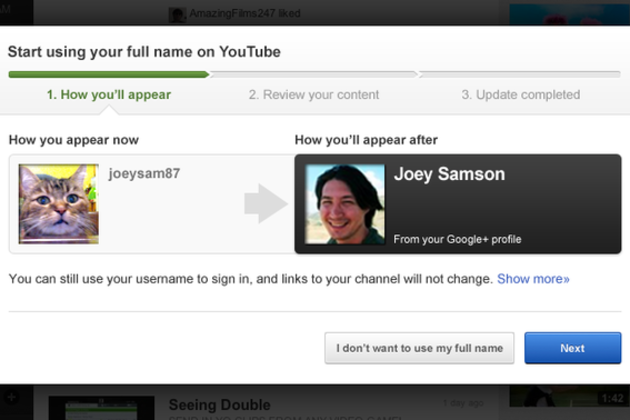
When Google's Vic Gundotra said the company wanted to use Google+ as the backbone of its web presence, he meant it. The company's YouTube blog has just announced that users will be able to switch their current usernames to their Google+ profiles. Google's couching this in the language of a unified identity, suggesting that users' friends might be missing out on their work or just that they're tired of being known as "cutepuppies99." It's also, however, obliquely acknowledging the notoriety of YouTube comments and those who make them. Before changing their settings, users can review their comments and videos to make sure they're comfortable associating them with a real name. It's also possible to associate the Google+ account while...
Continue reading…
When Google's Vic Gundotra said the company wanted to use Google+ as the backbone of its web presence, he meant it. The company's YouTube blog has just announced that users will be able to switch their current usernames to their Google+ profiles. Google's couching this in the language of a unified identity, suggesting that users' friends might be missing out on their work or just that they're tired of being known as "cutepuppies99." It's also, however, obliquely acknowledging the notoriety of YouTube comments and those who make them. Before changing their settings, users can review their comments and videos to make sure they're comfortable associating them with a real name. It's also possible to associate the Google+ account while...
Continue reading…
Google secures Jelly Bean’s Face Unlock feature with Liveness Check
Google secures Jelly Bean’s Face Unlock feature with Liveness Check:

Google has improved the security of its Face Unlock feature for the upcoming Android 4.1 Jelly Bean release. The feature was first introduced with Android 4.0 Ice Cream Sandwich as a way to unlock your phone through face recognition. However, it was quickly discovered that it could be tricked by a using a photo of the person.
With Jelly Bean, Google is adding a new option called Liveness Check for the Face Unlock feature that will require you to blink in order to unlock your device. The face recognition portion of it is faster than before and a message is then displayed asking you to “Blink now.” Your device then unlocks once you blink.
To add this feature, you will need to check the box in the security section of the settings on your device. Although the Liveness Check does improve the security issue with Face Unlock, there’s still the possibility that those determined to get into your device could doctor a video or animated GIF of your face, played back using another smartphone screen.
[via TechCrunch]
Google secures Jelly Bean’s Face Unlock feature with Liveness Check is written by Rue Liu & originally posted on SlashGear.
© 2005 - 2012, SlashGear. All right reserved.

Google has improved the security of its Face Unlock feature for the upcoming Android 4.1 Jelly Bean release. The feature was first introduced with Android 4.0 Ice Cream Sandwich as a way to unlock your phone through face recognition. However, it was quickly discovered that it could be tricked by a using a photo of the person.
With Jelly Bean, Google is adding a new option called Liveness Check for the Face Unlock feature that will require you to blink in order to unlock your device. The face recognition portion of it is faster than before and a message is then displayed asking you to “Blink now.” Your device then unlocks once you blink.
To add this feature, you will need to check the box in the security section of the settings on your device. Although the Liveness Check does improve the security issue with Face Unlock, there’s still the possibility that those determined to get into your device could doctor a video or animated GIF of your face, played back using another smartphone screen.
[via TechCrunch]
Google secures Jelly Bean’s Face Unlock feature with Liveness Check is written by Rue Liu & originally posted on SlashGear.
© 2005 - 2012, SlashGear. All right reserved.
The results are in: Google Search destroys Apple’s Siri
The results are in: Google Search destroys Apple’s Siri:

Every since Apple unveiled Siri, they tried to make us believe it was this amazing product that could never be wrong. Steve Jobs led us to believe it was as good if not better than Google search, and many people have attempted to prove or disprove this on a smaller scale. We really needed a more comprehensive test. That test has been conducted and things don’t look good for Siri.
Before you go thinking that an Android fanboy did the test, it was Piper Jaffrey’s Gene Munster. Gene is an Apple fanboy. In fact I blasted him in a recent post about his survey that showed developers favor Apple. He put together 1600 questions and asked both Siri and Google. He also went a step further and asked 800 of the questions in a quiet environment and the other 800 on the busy streets of Minneapolis. Hit the break for the results.
Since he didn’t use Google’s Voice Search, all questions were typed in for Google. It’s not surprising that Google understood 100% of the questions. On the other hand Siri was all voice and she understood the questions 83% of the time in noisy conditions and 89% of the time in a quiet environment. As to the results, Google was able to answer the questions accurately 86% of the time while Siri was able to get it right 62% of the time on the street and 68% of the time in a quiet room. Munster graded Google with a B+ and Siri with a D.
“In order to become a viable mobile search alternative,” Munster writes, “Siri must match or surpass Google’s accuracy of B+ and move from a grade D to a B or higher.”
According to Wiki, Siri gets 60% of its answers from Google, 20% from Yelp, 14% from WolframAlpha, 4% from Yahoo and 2% from Wikipedia. Here’s what Munster found:
“Breaking down Siri’s reliance further,” Munster writes, “Google provides 100% of navigation results, 61% of information results, 48% of commerce results and 42% of local results. Among other result aggregators, Yelp provided the most local results (51%) and commerce results (51%), while WolframAlpha provided 34% of information results.”
Siri is promised to be better in iOS 6, but that remains to be seen. Not only that, Apple is continuing to get away from Google. For example, with iOS 6, they will use their own Maps data and they will start to rely on Yahoo Sports for sports scores, Open Table for restaurant reservations, Rotten Tomatoes for movie show times, and Fandango for movie ticket purchases. Will this pay off for Apple or will the lack of accuracy remain?
Here are some of the questions Munster asked and how Siri handled them
I do find it interesting that Munster didn’t use Google’s Voice Search in this test, but I guess he really wanted to find out if Apple’s search queries were up to par with Google’s rather than see who can handle “voice” better.
source: fortune

Every since Apple unveiled Siri, they tried to make us believe it was this amazing product that could never be wrong. Steve Jobs led us to believe it was as good if not better than Google search, and many people have attempted to prove or disprove this on a smaller scale. We really needed a more comprehensive test. That test has been conducted and things don’t look good for Siri.
Before you go thinking that an Android fanboy did the test, it was Piper Jaffrey’s Gene Munster. Gene is an Apple fanboy. In fact I blasted him in a recent post about his survey that showed developers favor Apple. He put together 1600 questions and asked both Siri and Google. He also went a step further and asked 800 of the questions in a quiet environment and the other 800 on the busy streets of Minneapolis. Hit the break for the results.
Since he didn’t use Google’s Voice Search, all questions were typed in for Google. It’s not surprising that Google understood 100% of the questions. On the other hand Siri was all voice and she understood the questions 83% of the time in noisy conditions and 89% of the time in a quiet environment. As to the results, Google was able to answer the questions accurately 86% of the time while Siri was able to get it right 62% of the time on the street and 68% of the time in a quiet room. Munster graded Google with a B+ and Siri with a D.
“In order to become a viable mobile search alternative,” Munster writes, “Siri must match or surpass Google’s accuracy of B+ and move from a grade D to a B or higher.”
According to Wiki, Siri gets 60% of its answers from Google, 20% from Yelp, 14% from WolframAlpha, 4% from Yahoo and 2% from Wikipedia. Here’s what Munster found:
“Breaking down Siri’s reliance further,” Munster writes, “Google provides 100% of navigation results, 61% of information results, 48% of commerce results and 42% of local results. Among other result aggregators, Yelp provided the most local results (51%) and commerce results (51%), while WolframAlpha provided 34% of information results.”
Siri is promised to be better in iOS 6, but that remains to be seen. Not only that, Apple is continuing to get away from Google. For example, with iOS 6, they will use their own Maps data and they will start to rely on Yahoo Sports for sports scores, Open Table for restaurant reservations, Rotten Tomatoes for movie show times, and Fandango for movie ticket purchases. Will this pay off for Apple or will the lack of accuracy remain?
Here are some of the questions Munster asked and how Siri handled them
- What team does Peyton Manning play for? Responded with the answer to the previous query. This was the most common error.
- Where is Elvis buried? Responded I can’t answer that for you. It thought the persons name was Elvis Buried.
- Where am I? Pin dropped in the wrong place.
- When did the movie Cinderella come out? Responded with a movie theater search on Yelp.
- How do I get from Boston to New York? Responded I can only give directions from your current location. I cant give you directions to a place you are not in.
- What spices are in Lasagna? Responded with a Yelp search with lasagna on the menu.
- When is the next Haley’s comment? Responded “You have no meetings matching Haley’s”
- I want to go to Lake Superior? Responded with directions to the company Lake Superior X-Ray.
I do find it interesting that Munster didn’t use Google’s Voice Search in this test, but I guess he really wanted to find out if Apple’s search queries were up to par with Google’s rather than see who can handle “voice” better.
source: fortune
New “Behind the Game” video arrives for Inversion
New “Behind the Game” video arrives for Inversion: 
Inversion is now available in stores for the PlayStation 3 entertainment system. Inversion puts players into the middle of a war with an unknown enemy equipped with advanced technology. The player must fight their enemy and try to take power of their technology in order to save the world. NAMCO BANDAI has just released another “Behind the Game” video to give you more insight of what awaits you in Inversion.… Read more
Inversion is now available in stores for the PlayStation 3 entertainment system. Inversion puts players into the middle of a war with an unknown enemy equipped with advanced technology. The player must fight their enemy and try to take power of their technology in order to save the world. NAMCO BANDAI has just released another “Behind the Game” video to give you more insight of what awaits you in Inversion.… Read more
Subscribe to:
Posts (Atom)